
How to properly warm the lambs?
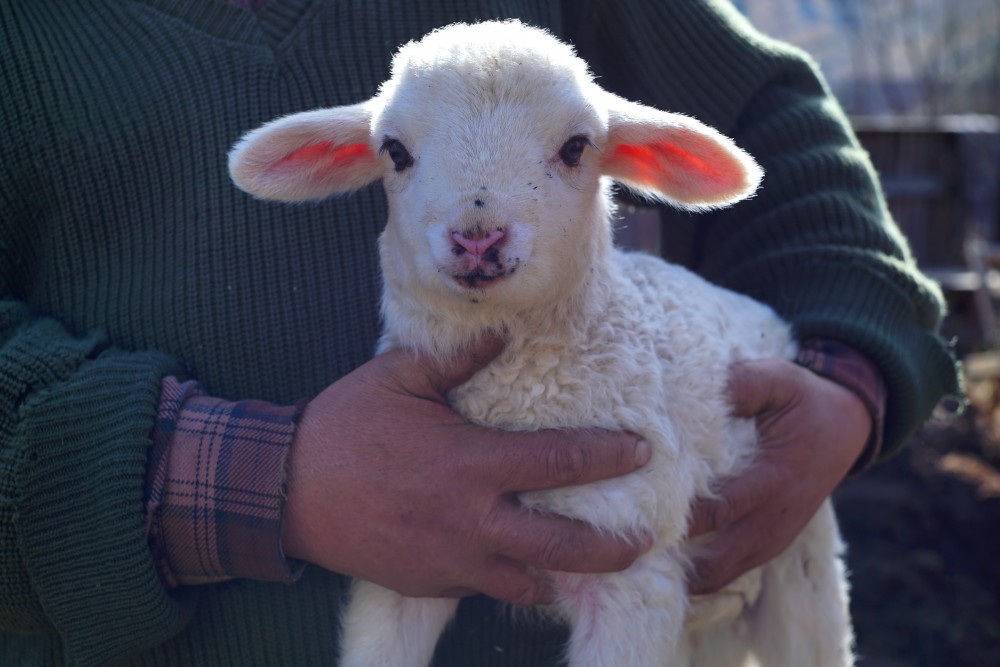
It is extremely important that the farmer examines the flock and the new lambs daily. A careful inspection reveals the lambs that are not well. The healthy lambs…
It is extremely important that the farmer examines the flock and the new lambs daily. A careful inspection reveals the lambs that are not well. Healthy lambs usually, at any disturbance, run to the mother and want to suckle. Doubts are subject to review.
Lambs with a temperature lower than 37 0C need to be warmed in a special warm box. It can be made in any farm from a wooden crate. At half the height of the crate, a thick metal mesh is placed, through which the legs of the lamb do not fall. Perforated board can be used instead of mesh. The hypothermic lamb is placed above the net, and paper sacks are placed below to absorb the fallen faeces and urine.
A domestic electric fan heater, which is connected to a contact thermometer reading the temperature of the air immediately above the grid, is placed so that it blows from below towards the grid. The thermometer is adjusted to maintain 37 - 390C. The bottom of the crate should be open on one side where the heater is placed. To accommodate more lambs, removable partitions can be used at the top of the crate.
The bottom of the warm box can be built with bricks, which is safer from fire. The warm air envelops the lamb from everywhere and warms it. The body temperature of the lamb is measured every 20 minutes and when it reaches 37 0C, the lamb is removed from the warm box. If the temperature of the lamb is lowered by 2-5 0 C, it can be recovered in only half an hour, while with severe hypothermia and a temperature of only 20 0 C, it takes several hours for the lamb to return from the death that pays for it. Prompt action to save the young lambs and those with hypothermia is critical to success. The warm box and net must be disinfected after each lamb.